How Much Does It Cost to Build a Custom Home on Cape Cod? A 2026 Guide
If you’re considering a custom home build on Cape Cod, the first question you’re probably asking is the same one almost every homeowner asks us: what is this actually going to cost?
It’s the right question. And it deserves an honest answer — not a vague “it depends” or a generic per-square-foot number pulled from a national average. Cape Cod is its own market, with its own building conditions, its own materials costs, and its own permitting reality. A custom home here doesn’t cost what the same home would cost in central Massachusetts or in Boston, and it certainly doesn’t cost what a stock production home from a large builder costs.
This guide breaks down what actually goes into a Cape Cod custom home budget in 2026, what drives prices up or down, and how to plan realistically before you ever break ground.
The Short Answer: What Custom Homes Cost on Cape Cod in 2026
In 2026, custom home construction on Cape Cod generally runs between $500 and $900 per square foot for the home itself, with high-end coastal builds easily exceeding $1,000 per square foot. Total project costs — including land, site work, design, permitting, finishes, and landscaping — vary widely based on factors we’ll cover below.
To put that in real terms:
-
- A 2,500-square-foot custom home at mid-range finishes might run $1.5M–$2.2M for construction alone
-
- A 3,500-square-foot coastal property with premium finishes could run $2.5M–$3.5M+
-
- A smaller 1,800-square-foot cottage-style home with modest finishes might come in around $900K–$1.4M
These numbers don’t include land purchase, which on Cape Cod can range from $300K for an inland lot to several million dollars for waterfront property.
Now, here’s the honest part: these ranges are wide for a reason. No two custom homes on Cape Cod are alike, and the only way to get a real number for your specific project is to walk the site, talk through the scope, and develop a budget tied to actual decisions. Let’s look at why.
What Actually Drives Custom Home Costs on Cape Cod
Most builders won’t break this down for you because it complicates the sales conversation. We’re going to break it down anyway, because if you’re going to commit to a multi-year, multi-million-dollar project, you deserve to understand what you’re paying for.
1. Site Conditions and Land Preparation
Before a foundation is poured, the land itself has to be ready to build on. Cape Cod’s geology — sandy soils, high water tables in some areas, tight lots in historic villages — means site work can range from straightforward to extensive.
Cost factors include:
-
- Tree clearing and excavation — wooded lots add cost; open lots save it
-
- Soil quality and bearing capacity — sandy Cape soils sometimes require engineered foundations
-
- Septic system requirements — Cape Cod has strict Title 5 septic regulations, and innovative/alternative systems can run $25K–$60K+
-
- Well drilling (if not on town water) — typically $10K–$25K
-
- Drainage, grading, and erosion control — especially on coastal or sloped properties
-
- Tree protection and landscape preservation — historic district lots often have significant requirements here
Expect site work to add 5–15% of total project cost, sometimes more on challenging lots.
2. Design and Architecture
A true custom home starts with architectural design. Stock plans don’t fit Cape Cod the way custom plans do, and most homeowners pursuing a custom build do so precisely because they want a home tailored to them and their site.
Architectural design fees typically run 8–15% of construction cost, depending on the architect and scope. For a $2M build, that’s $160K–$300K in design fees.
Some builders bundle design into a design-build process, which can streamline costs and timelines. Others work with independent architects, which gives homeowners more design flexibility but adds coordination complexity.
3. Permitting and Local Compliance
Cape Cod has more layers of permitting than most areas of Massachusetts, and each town has its own process. Depending on your location, your project may need to navigate:
-
- Town building department — standard building permits
-
- Conservation Commission — if your lot is near wetlands, vernal pools, or coastal resource areas
-
- Old King’s Highway Regional Historic District Commission — covers properties north of Route 6 in Sandwich, Barnstable, Yarmouth, Dennis, Brewster, and Orleans
-
- Local historic districts — Chatham, South Dennis, Yarmouth Port, Brewster, and others have additional design review
-
- Cape Cod Commission — for larger or more complex projects, regional review may apply
-
- Health Department — septic, well, and food service approvals where applicable
Permitting can add 3–8% to project costs, plus weeks to months of timeline. An experienced local builder is essential here — fumbling the permitting process can cost months of carrying costs and tens of thousands in delays.
4. Building Materials and Coastal Construction Standards
Building on Cape Cod means building for the Cape Cod climate — salt air, wind, moisture, temperature swings, and in some cases coastal flood zones. This isn’t optional; it’s how you build a home that holds up for the long term.
Cape Cod–specific material considerations:
-
- Cedar shingles are the regional standard for exteriors — beautiful, durable, but more expensive than vinyl or fiber cement
-
- Marine-grade fasteners prevent corrosion from salt air
-
- Premium windows rated for coastal wind loads
-
- High-quality insulation to meet Massachusetts Stretch Energy Code requirements
-
- Coastal-rated framing lumber for homes in flood zones or high-wind areas
-
- Quality roofing materials rated for coastal exposure
Material costs have remained elevated since 2021 and continued to fluctuate through 2025. As of early 2026, lumber prices have stabilized somewhat, but specialty materials — windows, doors, premium finishes — remain higher than pre-pandemic levels.
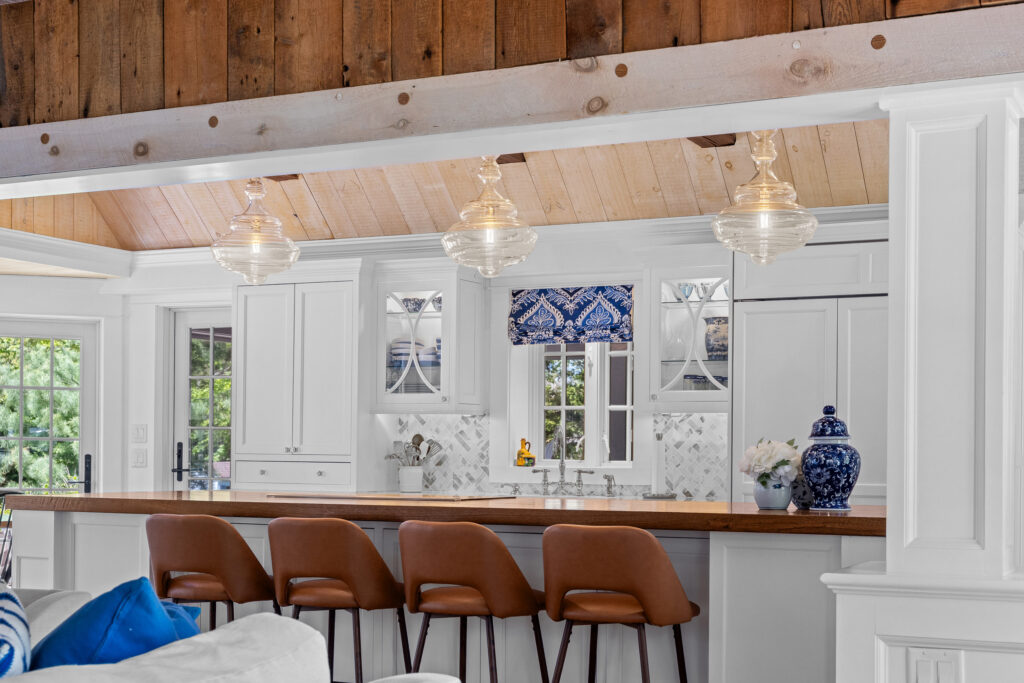
5. Interior Finishes and Fixtures
This is where Cape Cod custom home budgets vary most dramatically. The same 3,000-square-foot home can cost $1.5M with mid-range finishes or $3M+ with high-end finishes.
Finish-level cost drivers:
| Finish Category | Mid-Range | High-End |
|---|---|---|
| Kitchen cabinets & countertops | $40K–$80K | $100K–$250K+ |
| Bathrooms (per bath) | $15K–$30K | $40K–$100K+ |
| Flooring | $8–$15/sq ft | $20–$50+/sq ft |
| Lighting & fixtures | $15K–$30K | $50K–$150K+ |
| Interior trim & millwork | Stock profiles | Custom built-ins, wainscoting, paneled walls |
| Appliances | $15K–$30K | $50K–$150K+ |
The right finish level depends on your budget, your priorities, and your long-term plans for the home. A primary residence often justifies higher finish investment than a seasonal home.
6. Mechanical Systems
Modern Cape Cod homes require modern mechanical systems — and the Massachusetts Stretch Energy Code, which most Cape Cod towns have adopted, sets higher efficiency standards than the base state code.
Typical mechanical system costs for a custom home:
-
- HVAC (heating, cooling, ventilation) — $25K–$60K
-
- Plumbing rough-in and fixtures — $30K–$80K
-
- Electrical — $25K–$70K
-
- Insulation (to meet Stretch Code) — $15K–$40K
-
- Smart home and security systems — $10K–$50K+
Energy-efficient systems and renewable upgrades (heat pumps, solar, battery storage) add upfront cost but can significantly reduce long-term operating expenses — important for both year-round and seasonal homes.
7. Outdoor and Landscape Work
Cape Cod homes live as much outdoors as indoors — and the landscape, hardscape, and outdoor structures often represent a significant additional investment.
Common outdoor project costs:
-
- Decking and porches — $30K–$150K+ depending on size and materials
-
- Pools — $80K–$250K+ for in-ground installations
-
- Hardscaping (patios, walkways, retaining walls) — $20K–$100K+
-
- Professional landscaping — $25K–$150K+
-
- Outdoor kitchens and entertaining areas — $30K–$100K+
These are often phased after move-in, but planning for them in the original budget prevents cost surprises later.
The Hidden Costs Most Homeowners Don’t Plan For
Beyond the line items above, several costs catch homeowners off guard. Knowing about them in advance helps you plan a realistic budget.
Carrying costs during construction. A custom Cape Cod build typically takes 12–18 months. During that time, you’re paying property taxes, insurance, and (if you’re using construction financing) interest on the loan. For a $2M build, this can easily add $50K–$100K to total project costs.
Change orders. Even with careful planning, most projects involve some changes during construction — a wall moved, a finish upgraded, a system added. Industry standard is to budget 5–10% contingency for changes.
Furnishing the home. Custom homes deserve furnishings that match. Furniture, window treatments, art, and styling are typically separate from construction budget — but for a 3,000+ square-foot home, this can run $100K–$500K+.
Post-construction landscape and finishing. Final grading, sod, plantings, and exterior finishing often run beyond initial landscape estimates.
How to Plan Your Cape Cod Custom Home Budget
Here’s the realistic approach we recommend to every Cape Cod homeowner planning a custom build:
1. Start with a number you’re comfortable with — including everything. Land, design, build, contingency, carrying costs, landscaping, furnishings. If your total comfort number is $2.5M all-in, work backward from there to figure out what’s possible.
2. Talk to a builder before you finalize plans. Architects design beautiful homes. Builders know what those homes cost to build. Bringing a builder into early conversations — even before plans are finalized — can save tens or hundreds of thousands of dollars in design revisions.
3. Be realistic about timeline. A rushed Cape Cod custom build is almost always a more expensive Cape Cod custom build. Quality trades book out months in advance. Materials sometimes have lead times of 6+ months. Planning for an 18–24 month process from concept to keys is reasonable.
4. Build in contingency. A 10% contingency on construction costs is the floor, not the ceiling. Older homes, complex sites, and historic districts often warrant 15–20% contingency.
5. Understand the value equation. A custom home is an investment in how you’ll live for 20, 30, or 50 years. Cutting corners on systems, insulation, or quality materials to save 5% upfront often costs 20%+ over the home’s lifetime in repairs, replacements, and energy bills.
How Betterwood Homes Approaches Custom Home Budgets
We’ve spent decades building custom homes across Dennis, Brewster, Yarmouth, Harwich, Chatham, and Orleans. Our approach to budgeting starts with a free consultation, where we walk your site, talk through your vision, and develop a realistic understanding of what your project will cost.
We don’t quote per-square-foot numbers in the abstract because they don’t reflect reality. Instead, we develop a detailed budget tied to your specific project — your site, your scope, your finishes, your timeline — so you know what you’re committing to before you commit.
That honest, transparent approach is why most of our work comes from referrals and repeat clients. It’s the only way we know how to build.
Frequently Asked Questions
Q: Is it cheaper to renovate an existing home or build new on Cape Cod? Renovation can be less expensive if the existing home has good bones and a reasonable layout. But for major reconfigurations, structural changes, or homes with significant deferred maintenance, the cost gap between renovation and new construction often narrows considerably. We can help you evaluate which makes sense for your situation.
Q: How long does a custom home build take on Cape Cod? From signed plans to move-in, expect 12–18 months for a typical custom home. Add 6–12 months upfront for design, permitting, and budgeting. Complex sites, historic districts, and large or unusual projects can extend timelines further.
Q: Do I need to own the land before talking to a builder? No. In fact, we often help homeowners evaluate potential lots before they buy — assessing buildability, site work costs, and any zoning or conservation issues. Talking to a builder before you purchase land can save significant money and headaches.
Q: What’s included in a Betterwood Homes custom build budget? Our budgets include design coordination, permitting, all construction labor and materials, site work, mechanical systems, interior finishes, and project management. We’re transparent about what’s in scope and what’s separate (landscaping, furnishings, etc.) so there are no surprises.
Q: Do you offer fixed-price contracts or cost-plus? We work with both approaches depending on the project. Cost-plus is common for highly custom projects where scope evolves; fixed-price contracts work well when scope is locked in early. We’ll recommend the right approach for your project during our initial conversations.
Ready to Talk About Your Cape Cod Build?
If you’re planning a custom home on Cape Cod, we’d love to talk through your project. There’s no obligation — just an honest conversation about what’s possible, what it might cost, and whether Betterwood Homes is the right fit.